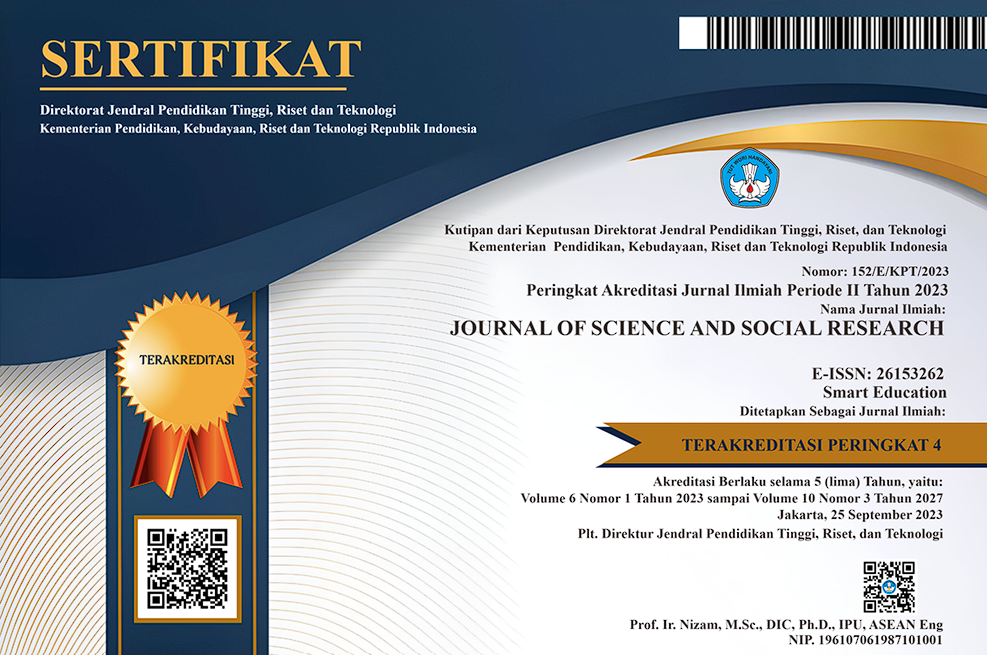
PENGARUH KEPEMIMPINAN TRANSFORMASIONAL DAN FASILITAS KERJA TERHADAP KINERJA KARYAWAN DENGAN MOTIVASI KERJA SEBAGAI VARIABEL INTERVENING PADA KANTOR KEUSKUPAN AGATS
DOI:
https://doi.org/10.54314/jssr.v9i4.7059Keywords:
Transformational Leadership, Work Facilities, Work Motivation, Employee PerformanceAbstract
This study aims to analyze the effect of transformational leadership and work facilities on employee performance, both directly and indirectly through work motivation as an intervening variable at the Agats Diocese Office. The study is grounded in the importance of strengthening leadership, work facilities, and motivation to improve employee performance effectiveness within a religious organization operating amid the geographical challenges of Asmat, South Papua. A quantitative method with an explanatory approach was applied. Data were collected through questionnaires distributed to all employees of the Agats Diocese Office using a census (total sampling) technique, obtaining 50 valid respondents from a population of 59 employees. Data analysis was conducted using Structural Equation Modeling – Partial Least Squares (SEM-PLS) to examine the causal relationships among the research variables. The results indicate that transformational leadership and work facilities each have a positive and significant effect on work motivation, but do not have a significant direct effect on employee performance. Work motivation itself has a positive and highly significant effect on employee performance, and is proven to fully mediate the relationship between both transformational leadership and work facilities toward employee performance. These findings confirm that employee performance at the Agats Diocese Office can only be improved when leadership and facilities are first converted into stronger work motivation.
Downloads
References
Aggarwal, S. (2024). Organizational culture and employee performance. IIMB Management Review. https://doi.org/10.1016/j.iimb.2024.07.001
Akbarurrijal, A., Hidayati, N., & Nurhidayah. (2026). Transformational leadership, organizational culture, and member performance: The mediating role of motivation. Journal of Social Work and Science Education, 7(1), 234–246.
Al-Aamri, M. S. H., Soliman, M., & Ponniah, L. S. (2024). Workplace environment and academic staff performance. Journal of Applied Research in Higher Education.
Bahiroh, E., & Ikhlas, R. (2024). Transformational leadership and employee engagement and motivation. Management Studies and Business Journal, 1(9), 1250–1271.
Bass, B. M., & Riggio, R. E. (2006). Transformational leadership (2nd ed.). Lawrence Erlbaum Associates.
Creswell, J. W., & Creswell, J. D. (2018). Research design: Qualitative, quantitative, and mixed methods approaches (5th ed.). Sage Publications.
Dartey-Baah, K., & Ampofo, E. Y. (2020). Leadership styles and employee work outcomes: The moderating role of organizational culture. International Journal of Business, Humanities and Technology, 10(1), 45–52.
Ghozali, I. (2021). Aplikasi analisis multivariate dengan program IBM SPSS 26. Badan Penerbit Universitas Diponegoro.
Hair, J. F., Hult, G. T. M., Ringle, C. M., & Sarstedt, M. (2022). A primer on partial least squares structural equation modeling (PLS-SEM) (3rd ed.). Sage Publications.
Henseler, J., Ringle, C. M., & Sarstedt, M. (2015). A new criterion for assessing discriminant validity in variance-based structural equation modeling. Journal of the Academy of Marketing Science, 43(1), 115–135.
Hidayah, T. (2025). The role of transformational leadership in improving organisational performance. International Journal of Economics, 4(1), 234–244.
Hussain, N. H. M., Nazari, P. N. A., & Husin, N. (2024). Transformational leadership and organizational performance. E-Jurnal Penyelidikan dan Inovasi, 11(2), 177–195.
Kim, J., & Park, S.-H. (2022). The effect of workplace environment on employee performance: Evidence from organizational behavior research. Sustainability, 14(5), 2785.
Martinho, E., & Donald, M. (2024). Transformational leadership and motivation mediated by organizational culture. Jurnal Ekonomi Efektif, 6(3), 523–532.
Northouse, P. G. (2022). Leadership: Theory and practice (9th ed.). Sage
Publications.
Oroh, O., Ariyadi, M. Y., & Fadlan, A. F.
(2024). The influence of transformational leadership on employee motivation and performance. International Journal of Management Science and Information Technology, 4(2), 336–345.
Robbins, S. P., & Judge, T. A. (2022). Organizational behavior (18th ed.). Pearson.
Ryan, R. M., & Deci, E. L. (2020). Intrinsic motivation and self-determination in human behavior: Contemporary perspectives. Springer.
Sekaran, U., & Bougie, R. (2020). Research methods for business: A skill-building approach (8th ed.). Wiley.
Shahzad, S., Xiu, G., & Shahbaz, M. (2022). Transformational leadership and firm performance: The mediating role of innovation. Journal of Innovation & Entrepreneurship, 11(1), 1–18.
Sugiyono. (2022). Metode penelitian kuantitatif, kualitatif, dan R&D. CV Alfabeta.
Sutrisno, E. (2019). Manajemen sumber daya manusia. Kencana Prenada Media Group.
Tran, K. T., Nguyen, P. V., & Pham, N. H. T. (2021). Transformational leadership and employee creativity. International Journal of Business and CRM, 15(2).
Yang, W., & Villanueva, L. E. (2024). Transformational leadership practices and achievement motivation. Journal of Education and Educational Research, 9(1), 332–342.
Downloads
Published
Issue
Section
License
Copyright (c) 2026 Hilarius Salmon, Ike Kusdyah Rachmawati, Adriani Kala’lembang (Author)

This work is licensed under a Creative Commons Attribution-ShareAlike 4.0 International License.